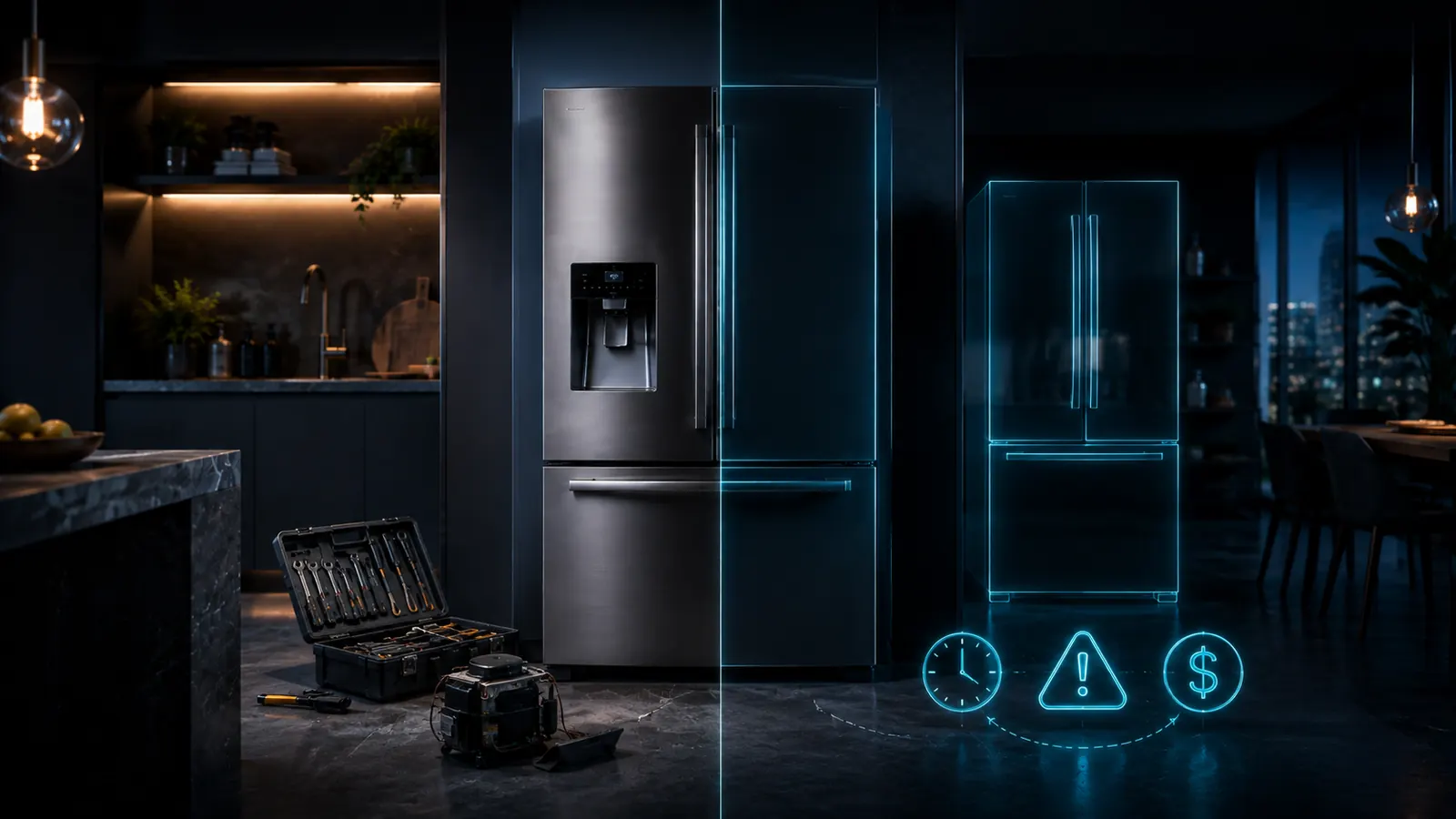
The “50 percent rule” is appealing because it turns a messy decision into arithmetic: if a repair costs more than half of replacement, buy new. The problem is that two appliances with the same repair percentage can have completely different futures. A three-year-old refrigerator with an expensive but covered component is not equivalent to a twelve-year-old unit with three emerging faults.
Consumer Reports uses product-specific repair, depreciation and survey data rather than a single universal cutoff in its repair-or-replace tools for washers, refrigerators and dishwashers. That is a better model for ownership decisions: combine several pieces of evidence and accept that uncertainty remains.
Factor 1: the diagnosed failure
Start with what actually failed. A door latch, hose, sensor or pump is a different proposition from a cracked tub, sealed-system failure or structural corrosion. The repair should restore a meaningful function without leaving a known expensive problem untouched.
Factor 2: age relative to expected service life
Age changes future-failure risk, but it should be compared with a realistic service-life range rather than a made-up expiry date. PNNL’s review of appliance-life studies shows broad ranges for many categories. An appliance at the center of its expected range may have years left; one far beyond the range has more uncertainty.
Factor 3: cost per recovered year
Estimate how many additional years the repair is likely to buy, then divide repair cost by that estimate. A $240 repair that plausibly buys four more years costs roughly $60 per recovered year. A $500 repair that may buy one more year is a very different proposition.
This is not precise forecasting. Its value is forcing you to think beyond today’s invoice.
Factor 4: the condition of the rest of the appliance
A repair quote usually addresses the diagnosed fault, not every aging component. Look for bearing noise, corrosion, cracked seals, repeated error codes, damaged racks, failing displays and prior repair history. One isolated problem is a stronger repair case than several unrelated signs of decline.
Factor 5: parts availability and repair confidence
A $150 part that is in stock and supported by clear service information is not equivalent to a discontinued module available only from uncertain suppliers. Ask whether the part is genuine or approved, how long it will take to arrive and what warranty applies to the completed repair.
Factor 6: downtime and consequences of failure
Downtime has different value for different appliances. A broken dishwasher can be tolerated by hand washing. A refrigerator can create food-loss risk within hours. A washer may be critical for a large household. Include temporary workarounds and waiting time in the decision.
Factor 7: the quality and cost of the actual replacement
Do not compare a repair with the cheapest appliance you can find online if that product does not match your capacity, features, installation and expected quality. Include delivery, installation kits, removal, cabinetry changes and any required electrical or plumbing work.
A practical scoring framework
| Question | Repair-favorable answer | Replace-favorable answer |
|---|---|---|
| Fault isolated? | Yes | Multiple or structural faults |
| Age position | Early/mid life | Late life with other wear |
| Repair share of replacement | Low/moderate | High |
| Recovered life | Several plausible years | Uncertain or short |
| Parts | Available and supported | Discontinued/backordered |
| Repair confidence | Clear diagnosis | Guesswork / repeated failed repairs |
| Replacement benefit | Little added value | Solves major efficiency/capacity/reliability issues |
Why environmental arguments should be careful
Repairing a serviceable appliance generally avoids manufacturing a replacement immediately, but energy use matters too. A very inefficient old appliance may have a legitimate replacement case if measured operating savings are significant. The correct approach is to calculate energy and water differences rather than use sustainability as a slogan in either direction.
Questions to ask before authorizing a repair
- What exact part or system has failed?
- What is the total price including labor, tax and return visits?
- What warranty applies to the repair?
- Are there other visible signs of wear that could become expensive soon?
- Is the required part normally available?
- How old is the appliance relative to its typical lifespan?
- What does a genuinely comparable replacement cost installed?
The decision in one sentence
Repair when the work is likely to restore a healthy appliance for meaningful additional service at a sensible cost. Replace when the repair is expensive because the product as a whole—not just one part—is approaching the end of useful ownership.
A sensible troubleshooting mindset
The goal of troubleshooting is not to replace parts until the symptom disappears. Start with observations that can separate categories of failure, change one variable at a time, and keep notes if the symptom is intermittent. This is especially important on modern products where controls can compensate for a developing fault and where one error message can have several possible causes.
Model-specific documentation should override generic internet advice. Manufacturers change component layouts, service access, error codes and maintenance requirements between generations. A procedure that is safe on one model can create leaks, electrical risk or damage on another. If a step requires live electrical measurement, refrigerant work, opening a sealed lithium pack, gas-system repair or defeating a safety interlock, it has moved beyond ordinary owner maintenance.
For Owngevity, a good repair is one that restores useful service without creating disproportionate safety, cost or reliability risk. That is why these guides separate low-risk checks from component diagnosis and why lifespan estimates are expressed as ranges instead of fake precision.
Before you spend money: document the symptom
Good troubleshooting becomes much easier when the symptom is described precisely. Note what the appliance does, when it happens, whether the behavior is repeatable and whether anything changed immediately before the problem started. Record model and serial information before ordering parts or contacting service. If an error code appears, photograph it and use the manual for that exact model rather than relying on a code list for a different generation.
Also separate a performance complaint from a failure. A machine that still completes its intended job but does it less conveniently may need maintenance or an adjustment; a product that leaks, overheats, trips protection devices or cannot perform a core function has a different risk profile. This distinction keeps small issues from turning into unnecessary replacement decisions.
How to judge a repair quote
Ask what has actually been diagnosed, which part will be replaced, whether the quote includes labor and return visits, and what warranty applies to the work. A clear diagnosis with a defined part and total price is more valuable than a low estimate based on guesswork. If the repair is expensive, ask whether the technician sees evidence of other wear that could become significant soon.
Compare the quote with a genuinely equivalent replacement, not simply the cheapest product in the category. Include delivery, installation, accessories, disposal and any changes needed to fit the new product. A replacement that appears only slightly more expensive can cost substantially more once those items are added.
What Owngevity means by “repairable”
Repairable does not mean every owner should perform the repair. It means the product can reasonably be restored with available parts, appropriate tools and competent service. Electrical work, refrigerant circuits, lithium-ion battery packs, gas components and sealed pressure systems can create hazards that are not justified by a small saving. Owner maintenance should stop where the manufacturer’s documentation or your competence stops.
That distinction matters for longevity. The goal is not to keep every product alive at any cost; it is to avoid throwing away useful equipment because of a minor or misunderstood fault while also recognizing when continued repair creates poor value or unnecessary risk.
After the problem is solved
Once normal operation returns, make a short record of what caused the issue and what fixed it. This creates a useful maintenance history and can reveal patterns if a similar symptom returns. If the cause was a restriction, contamination, poor installation or neglected routine care, adjust the maintenance schedule rather than waiting for the same failure to repeat.
Finally, verify the result under normal use rather than assuming the first successful cycle proves everything is fixed. Watch for leakage, abnormal heat, new noises, repeated errors and changes in performance. A repair that restores stable operation is valuable; a repair followed immediately by new symptoms deserves another diagnosis rather than another round of random parts replacement.