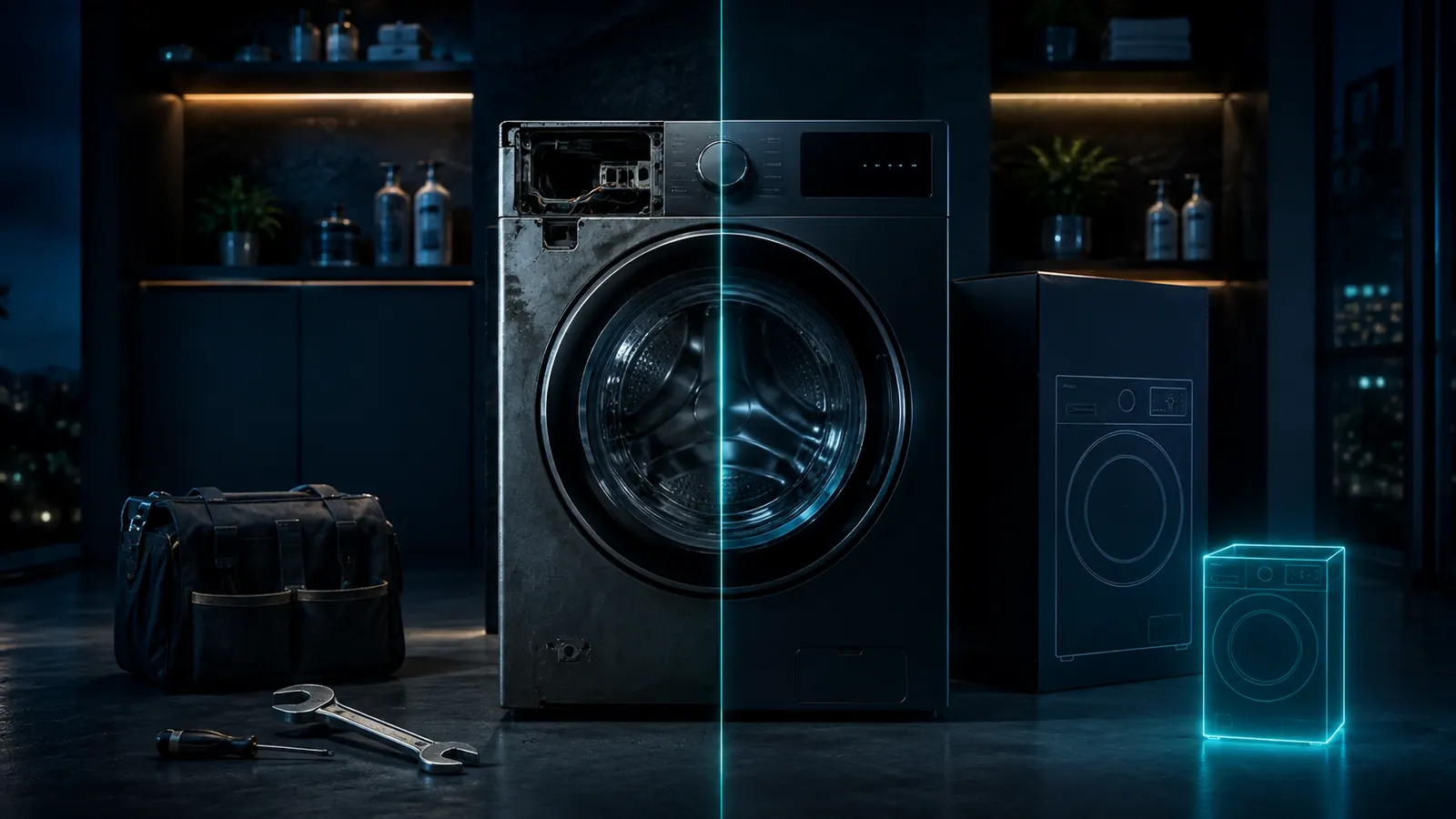
A washing machine that suddenly stops draining, locking, spinning or heating can feel like a binary decision: pay for a repair or buy a new one. In practice, the best choice is rarely determined by age alone and it is not captured by a single “50 percent rule.” A five-year-old washer with a badly damaged tub can be a poor repair candidate, while a ten-year-old machine with a straightforward pump fault may still deserve another chance.
The useful question is how much reliable service the repair is likely to buy. That means looking at the diagnosed fault, the price of the repair, the washer’s broader condition, the availability of parts and the amount of life the appliance has probably already consumed. Consumer Reports’ repair-or-replace work is useful here because it combines repair costs and age rather than treating every broken machine the same.
Start with the fault, not the age
A washer is a collection of systems that age at different rates. The cabinet can remain perfectly sound while a drain pump, door lock or inlet valve fails. Those are very different events from a cracked outer tub, severe bearing damage or repeated electronic faults. If the failed part is accessible, available and inexpensive relative to the machine, the repair case is stronger.
| Fault or symptom | Repair outlook | Why |
|---|---|---|
| Blocked filter or hose | Very favorable | Often a maintenance issue rather than a failed machine |
| Drain pump / door lock / inlet valve | Often favorable | Discrete parts and predictable labor on many models |
| Suspension components | Often favorable | Can restore vibration control if the tub and bearings are sound |
| Control board | Case by case | Part price and diagnostic confidence vary widely |
| Bearings / tub assembly | Often expensive | Labor can be substantial and some designs require large assemblies |
| Repeated unrelated failures | Weakening | Suggests the rest of the machine may also be entering a higher-risk period |
How age should influence the decision
Published appliance-life studies put washers broadly in the neighborhood of a decade, with substantial variation. That range should be used as context, not as a countdown. A machine used lightly and maintained well may have a very different wear history from a similar model serving a large household every day.
Age matters because it changes the risk that another component fails after the current repair. Spending a large amount on a two-year-old washer is easier to justify because most of the appliance’s expected service life remains. On a twelve-year-old machine, the same repair must compete with the probability that bearings, seals, suspension or electronics may be closer to failure.
Use a five-part repair test
1. Is the diagnosis reasonably certain?
Do not authorize an expensive repair based only on a symptom. “Will not spin” can mean a load-balance issue, lock problem, drain problem, motor-control fault or mechanical issue. The more expensive the proposed repair, the more important a confident diagnosis becomes. Paying to replace a costly board on a guess is very different from replacing a pump after a clear pump failure has been confirmed.
2. What percentage of a comparable replacement does the repair cost?
Repair cost divided by replacement cost is useful, but it is only one input. A $180 repair on a $700 replacement looks reasonable at roughly one quarter of replacement cost. A $500 repair is harder to defend, especially on an older machine. But a percentage cannot tell you whether the rest of the washer is in excellent condition or already noisy, rusty and leaking.
3. How much life could the repair realistically recover?
A repair that restores a healthy five-year-old washer may buy many years. A major repair on an eleven-year-old machine may only postpone replacement. Think in terms of cost per recovered year. If a $200 repair plausibly buys three additional years, that is about $67 per year before energy and water differences. Compare that with the annualized cost of replacement.
4. Are the expensive systems still healthy?
Listen for bearing rumble, look for rust or leakage around the tub, check whether the drum has excessive play, and consider whether the machine has had several recent faults. A washer with one isolated problem is a better repair candidate than one showing deterioration across multiple systems.
5. Are parts and service still realistically available?
A repair only makes sense if the correct part can be obtained and installed with reasonable confidence. Long backorders, discontinued assemblies or proprietary modules priced near the value of the appliance can shift the decision toward replacement even if the washer is not particularly old.
When repairing usually makes sense
- The machine is still in the earlier or middle part of its expected life.
- The fault is isolated and well diagnosed.
- The tub, bearings, cabinet and wiring appear healthy.
- The repair cost is modest compared with a genuinely comparable new washer.
- Parts are available and the repair has a reasonable warranty.
- The machine has otherwise been reliable and you are satisfied with its performance.
The environmental case often aligns with the financial one. Keeping a serviceable appliance in use avoids the material and manufacturing burden of premature replacement. That does not mean every old appliance should be kept indefinitely; it means replacement should solve a real reliability, efficiency or capability problem rather than simply respond to a repairable fault.
When replacement becomes the stronger option
- The tub or bearing system requires a very costly repair.
- The appliance has multiple recent faults rather than one isolated failure.
- There is significant corrosion, structural damage or leakage.
- Critical parts are discontinued or prohibitively expensive.
- The repair quote approaches the cost of a suitable replacement.
- The machine no longer meets your needs and replacement would solve more than the current fault.
Be careful with the idea that a new washer automatically pays for itself through efficiency. Newer models can use less water and electricity, but the savings vary with local utility rates, wash frequency and the efficiency of the machine being replaced. Energy savings should be calculated rather than assumed.
A simple example
Imagine an eight-year-old front-loader with a failed drain pump. A qualified diagnosis is clear, the rest of the machine is quiet and dry, and the total repair is $190. A comparable replacement would cost $750. Even though the washer is not young, the repair is only about 25 percent of replacement cost and addresses a discrete component. That is a reasonable repair case.
Now imagine the same washer has loud bearing noise, visible rust around the rear tub area and an intermittent control fault. Even if the pump repair remains $190, the broader condition changes the decision. The correct comparison is no longer “$190 vs $750”; it is “$190 plus a high risk of additional repairs vs starting over with a new machine.”
Do the cheap checks before calling the machine dead
Some apparent failures are maintenance or installation issues. Manufacturers such as Whirlpool and LG specifically direct owners to check drain-pump filters and drain hoses when a washer does not drain. Clearing debris can restore function without replacing any component. Always follow the model-specific manual and isolate power before accessing service areas.
If water is hot, the machine is leaking electrically, the breaker trips, you smell burning or you are unsure about safe access, stop troubleshooting and use qualified service. Repairability is valuable only when the repair is safe.