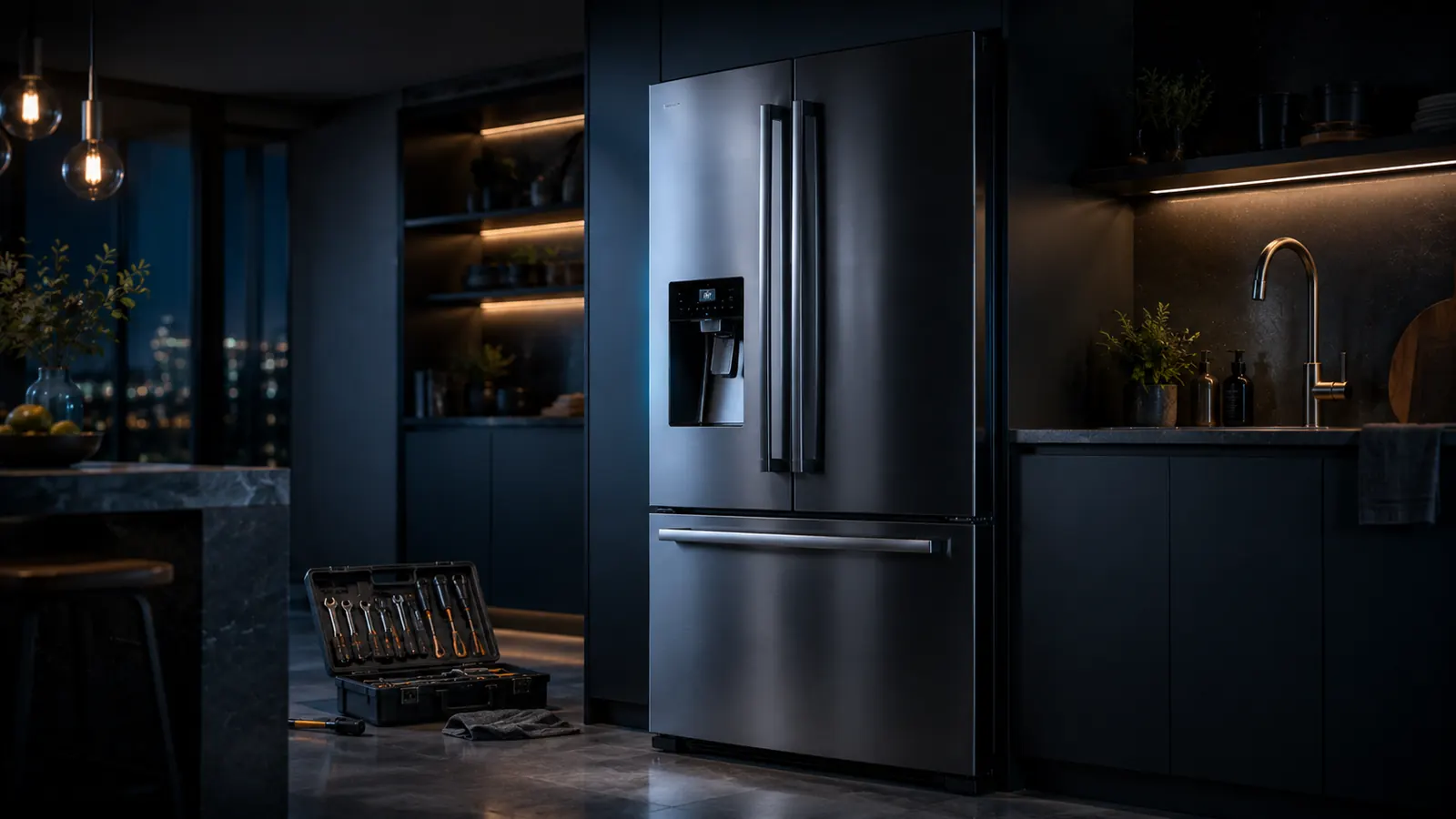
Refrigerators complicate the repair-or-replace decision because the consequences of failure are immediate. A washing machine can wait a few days; a refrigerator holding perishable food cannot. That urgency can push owners toward premature replacement before anyone has identified whether the fault is a $100-level component or a major sealed-system problem.
Consumer Reports’ survey-based guidance is unusually useful here. It reports that refrigerators are often repairable and says models less than ten years old are usually more economical to fix. That is not a universal rule, but it is a strong counterweight to the idea that any refrigerator fault means the appliance has reached the end of its life.
The type of failure matters more than the headline age
| Failure area | Repair outlook | Decision note |
|---|---|---|
| Door gasket / hinge / switch | Often favorable | Usually isolated and does not imply cooling-system wear |
| Evaporator or condenser fan | Often favorable | Discrete component if diagnosis is clear |
| Thermistor / thermostat / sensor | Often favorable | Part cost may be modest; diagnosis matters |
| Defrost system | Often repairable | Heater, sensor or control issue may be replaceable |
| Icemaker / dispenser | Optional-function decision | Main refrigerator may still cool normally |
| Control/inverter electronics | Case by case | Cost and parts availability vary |
| Compressor / sealed system | Potentially expensive | Specialized labor and refrigerant work raise cost |
Why sealed-system repairs change the equation
The compressor, refrigerant circuit and associated sealed components are different from replacing a door switch or fan motor. Diagnosis often requires specialized tools, and the labor can be substantial. Some newer refrigerators carry long component warranties on compressors but not necessarily labor, so warranty terms matter.
A sealed-system repair on a relatively young premium refrigerator may still be rational, especially if a warranty covers important parts. The same quote on an older entry-level unit with other emerging faults can be difficult to justify.
Separate cooling problems from convenience-feature problems
Modern refrigerators often combine core refrigeration with icemakers, water dispensers, touchscreens, cameras and network features. Failure of an icemaker does not mean the refrigeration system is finished. Consumer Reports’ reliability data notes icemakers and dispensers among commonly reported refrigerator problems. If the food compartments remain stable, you may choose to repair, disable or live without a convenience feature rather than replace the entire appliance.
Use cost per recovered year
Suppose a seven-year-old refrigerator needs a $260 fan and control repair and the rest of the appliance is in good condition. If that repair plausibly restores several years of service, the annualized cost can be reasonable. Now compare a $900 sealed-system quote on a twelve-year-old refrigerator with an aging icemaker and deteriorated door seals. The second repair must overcome much higher future-failure risk.
This way of thinking is better than a simple percentage rule because it rewards repairs that recover meaningful service life and penalizes repairs that merely postpone an inevitable replacement.
Check warranty coverage before paying
Refrigerators sometimes have different warranty periods for the whole appliance, sealed system and compressor. Read the exact warranty for the model and serial number. A quote that looks uneconomical at retail parts-and-labor pricing can become attractive if a major component is still covered.
Consider food-loss risk and downtime
Repair economics are not just the invoice. If parts are backordered for weeks and you cannot safely store food elsewhere, downtime has value. Conversely, replacing a repairable refrigerator immediately also has transaction costs: delivery, disposal, fit, door swing, water hookup and the risk that a new unit introduces different reliability problems.
Do not overstate the energy argument
A very old refrigerator can use substantially more electricity than an efficient new model, but the financial difference varies widely. Use the old unit’s measured or rated energy consumption and compare it with a realistic replacement. Multiply the difference by your electricity rate. Only then can efficiency savings be included honestly in the repair calculation.
Signs that repair is still the stronger choice
- The refrigerator is well under its expected service-life range.
- The fault is isolated and confidently diagnosed.
- The cabinet, doors and seals remain in good condition.
- Parts are available without excessive delay.
- The repair quote is modest relative to a comparable replacement.
- A warranty covers some or all of the expensive components.
Signs that replacement deserves serious consideration
- The refrigerator is already late in its expected life and has multiple faults.
- A major sealed-system repair approaches replacement cost.
- There is structural corrosion, liner damage or persistent water leakage.
- Critical components are discontinued or repeatedly backordered.
- Energy use is unusually high and a calculated replacement saving is meaningful.
- The appliance no longer fits your household needs and replacement solves more than the current failure.
The best decision is therefore not “repair old, replace new.” It is to identify the fault, price the repair, evaluate the rest of the refrigerator and ask how much reliable service the repair can realistically recover.
A sensible troubleshooting mindset
The goal of troubleshooting is not to replace parts until the symptom disappears. Start with observations that can separate categories of failure, change one variable at a time, and keep notes if the symptom is intermittent. This is especially important on modern products where controls can compensate for a developing fault and where one error message can have several possible causes.
Model-specific documentation should override generic internet advice. Manufacturers change component layouts, service access, error codes and maintenance requirements between generations. A procedure that is safe on one model can create leaks, electrical risk or damage on another. If a step requires live electrical measurement, refrigerant work, opening a sealed lithium pack, gas-system repair or defeating a safety interlock, it has moved beyond ordinary owner maintenance.
For Owngevity, a good repair is one that restores useful service without creating disproportionate safety, cost or reliability risk. That is why these guides separate low-risk checks from component diagnosis and why lifespan estimates are expressed as ranges instead of fake precision.
Before you spend money: document the symptom
Good troubleshooting becomes much easier when the symptom is described precisely. Note what the refrigerator does, when it happens, whether the behavior is repeatable and whether anything changed immediately before the problem started. Record model and serial information before ordering parts or contacting service. If an error code appears, photograph it and use the manual for that exact model rather than relying on a code list for a different generation.
Also separate a performance complaint from a failure. A machine that still completes its intended job but does it less conveniently may need maintenance or an adjustment; a product that leaks, overheats, trips protection devices or cannot perform a core function has a different risk profile. This distinction keeps small issues from turning into unnecessary replacement decisions.
How to judge a repair quote
Ask what has actually been diagnosed, which part will be replaced, whether the quote includes labor and return visits, and what warranty applies to the work. A clear diagnosis with a defined part and total price is more valuable than a low estimate based on guesswork. If the repair is expensive, ask whether the technician sees evidence of other wear that could become significant soon.
Compare the quote with a genuinely equivalent replacement, not simply the cheapest product in the category. Include delivery, installation, accessories, disposal and any changes needed to fit the new product. A replacement that appears only slightly more expensive can cost substantially more once those items are added.
What Owngevity means by “repairable”
Repairable does not mean every owner should perform the repair. It means the product can reasonably be restored with available parts, appropriate tools and competent service. Electrical work, refrigerant circuits, lithium-ion battery packs, gas components and sealed pressure systems can create hazards that are not justified by a small saving. Owner maintenance should stop where the manufacturer’s documentation or your competence stops.
That distinction matters for longevity. The goal is not to keep every product alive at any cost; it is to avoid throwing away useful equipment because of a minor or misunderstood fault while also recognizing when continued repair creates poor value or unnecessary risk.
After the problem is solved
Once normal operation returns, make a short record of what caused the issue and what fixed it. This creates a useful maintenance history and can reveal patterns if a similar symptom returns. If the cause was a restriction, contamination, poor installation or neglected routine care, adjust the maintenance schedule rather than waiting for the same failure to repeat.
Finally, verify the result under normal use rather than assuming the first successful cycle proves everything is fixed. Watch for leakage, abnormal heat, new noises, repeated errors and changes in performance. A repair that restores stable operation is valuable; a repair followed immediately by new symptoms deserves another diagnosis rather than another round of random parts replacement.