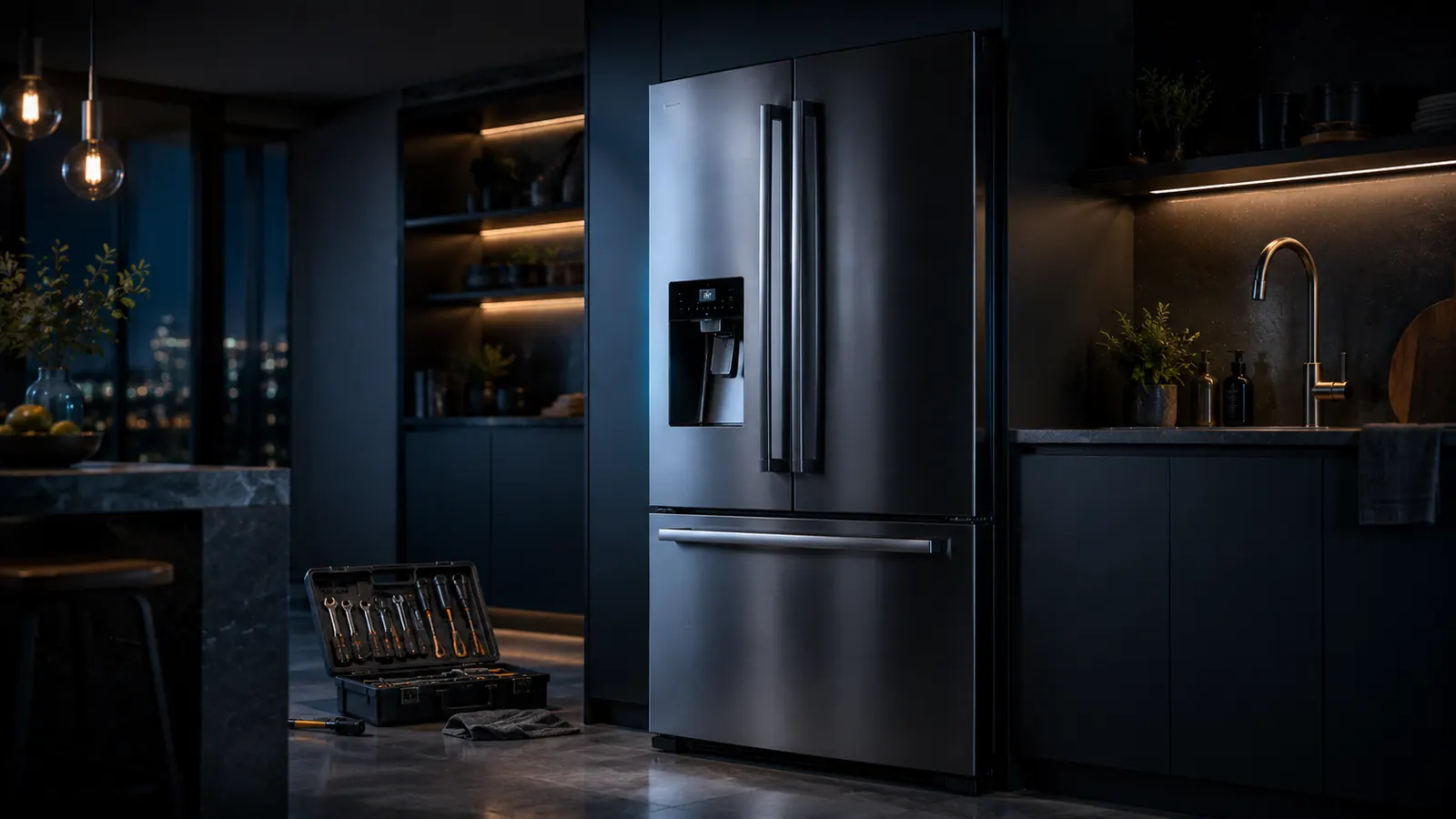
Refrigerators complicate the repair-or-replace decision because the consequences of failure are immediate. A washing machine can wait a few days; a refrigerator holding perishable food cannot. That urgency can push owners toward premature replacement before anyone has identified whether the fault is a $100-level component or a major sealed-system problem.
Consumer Reports’ survey-based guidance is unusually useful here. It reports that refrigerators are often repairable and says models less than ten years old are usually more economical to fix. That is not a universal rule, but it is a strong counterweight to the idea that any refrigerator fault means the appliance has reached the end of its life.
The type of failure matters more than the headline age
| Failure area | Repair outlook | Decision note |
|---|---|---|
| Door gasket / hinge / switch | Often favorable | Usually isolated and does not imply cooling-system wear |
| Evaporator or condenser fan | Often favorable | Discrete component if diagnosis is clear |
| Thermistor / thermostat / sensor | Often favorable | Part cost may be modest; diagnosis matters |
| Defrost system | Often repairable | Heater, sensor or control issue may be replaceable |
| Icemaker / dispenser | Optional-function decision | Main refrigerator may still cool normally |
| Control/inverter electronics | Case by case | Cost and parts availability vary |
| Compressor / sealed system | Potentially expensive | Specialized labor and refrigerant work raise cost |
Why sealed-system repairs change the equation
The compressor, refrigerant circuit and associated sealed components are different from replacing a door switch or fan motor. Diagnosis often requires specialized tools, and the labor can be substantial. Some newer refrigerators carry long component warranties on compressors but not necessarily labor, so warranty terms matter.
A sealed-system repair on a relatively young premium refrigerator may still be rational, especially if a warranty covers important parts. The same quote on an older entry-level unit with other emerging faults can be difficult to justify.
Separate cooling problems from convenience-feature problems
Modern refrigerators often combine core refrigeration with icemakers, water dispensers, touchscreens, cameras and network features. Failure of an icemaker does not mean the refrigeration system is finished. Consumer Reports’ reliability data notes icemakers and dispensers among commonly reported refrigerator problems. If the food compartments remain stable, you may choose to repair, disable or live without a convenience feature rather than replace the entire appliance.
Use cost per recovered year
Suppose a seven-year-old refrigerator needs a $260 fan and control repair and the rest of the appliance is in good condition. If that repair plausibly restores several years of service, the annualized cost can be reasonable. Now compare a $900 sealed-system quote on a twelve-year-old refrigerator with an aging icemaker and deteriorated door seals. The second repair must overcome much higher future-failure risk.
This way of thinking is better than a simple percentage rule because it rewards repairs that recover meaningful service life and penalizes repairs that merely postpone an inevitable replacement.
Check warranty coverage before paying
Refrigerators sometimes have different warranty periods for the whole appliance, sealed system and compressor. Read the exact warranty for the model and serial number. A quote that looks uneconomical at retail parts-and-labor pricing can become attractive if a major component is still covered.
Consider food-loss risk and downtime
Repair economics are not just the invoice. If parts are backordered for weeks and you cannot safely store food elsewhere, downtime has value. Conversely, replacing a repairable refrigerator immediately also has transaction costs: delivery, disposal, fit, door swing, water hookup and the risk that a new unit introduces different reliability problems.
Do not overstate the energy argument
A very old refrigerator can use substantially more electricity than an efficient new model, but the financial difference varies widely. Use the old unit’s measured or rated energy consumption and compare it with a realistic replacement. Multiply the difference by your electricity rate. Only then can efficiency savings be included honestly in the repair calculation.
Signs that repair is still the stronger choice
- The refrigerator is well under its expected service-life range.
- The fault is isolated and confidently diagnosed.
- The cabinet, doors and seals remain in good condition.
- Parts are available without excessive delay.
- The repair quote is modest relative to a comparable replacement.
- A warranty covers some or all of the expensive components.
Signs that replacement deserves serious consideration
- The refrigerator is already late in its expected life and has multiple faults.
- A major sealed-system repair approaches replacement cost.
- There is structural corrosion, liner damage or persistent water leakage.
- Critical components are discontinued or repeatedly backordered.
- Energy use is unusually high and a calculated replacement saving is meaningful.
- The appliance no longer fits your household needs and replacement solves more than the current failure.
The best decision is therefore not “repair old, replace new.” It is to identify the fault, price the repair, evaluate the rest of the refrigerator and ask how much reliable service the repair can realistically recover.
Before you spend money: document the symptom
Good troubleshooting becomes much easier when the symptom is described precisely. Note what the refrigerator does, when it happens, whether the behavior is repeatable and whether anything changed immediately before the problem started. Record model and serial information before ordering parts or contacting service. If an error code appears, photograph it and use the manual for that exact model rather than relying on a code list for a different generation.
What Owngevity means by “repairable”
Repairable does not mean every owner should perform the repair. It means the product can reasonably be restored with available parts, appropriate tools and competent service. Electrical work, refrigerant circuits, lithium-ion battery packs, gas components and sealed pressure systems can create hazards that are not justified by a small saving. Owner maintenance should stop where the manufacturer’s documentation or your competence stops.
Refrigerator repair decision: quote, fault and food loss
Ask the technician to identify the diagnosed failed component and distinguish a replaceable fan, sensor or gasket from a sealed-system repair. A broad label such as u201ccooling problemu201d is not a sufficient basis for replacing the refrigerator. Request the total installed price, parts availability and repair warranty.
Compare that total with a similar-capacity replacement including delivery, removal and any cabinet-fit modifications. Factor in the reliability of remaining components and the cost of repeated food loss; neither age alone nor a fixed 50-percent rule determines value.
If temperatures are unsafe or the appliance has an electrical or refrigerant fault, prioritize safe professional service. Do not keep using a unit that cannot maintain safe storage temperatures simply because the repair quote is lower than a new refrigerator.
Refrigerator repair: three decisions before accepting a quote
| What you observe | What to check or decide |
|---|---|
| Confirm the failure | Record temperatures with a separate thermometer, check whether the door closes fully, and note if the freezer and fresh-food compartment behave differently. A warm compartment alone does not identify a failed compressor. |
| Separate diagnosis from replacement parts | Ask the technician to identify the failed component, explain the diagnostic evidence and include labor, call-out charges and warranty terms in the written quote. |
| Account for the consequences of waiting | If the unit cannot maintain safe food-storage temperatures, prioritize food safety and temporary storage. Avoid comparing repair and replacement costs while ignoring recurring spoilage or downtime. |
| Consider what the quote does not fix | An isolated fan, control or gasket problem has different implications from recurring sealed-system problems or severe cabinet corrosion. Request an explanation of remaining risks before committing. |
This is a decision framework, not a diagnosis by symptom alone. Follow the refrigerator manufacturer’s safety instructions, and use qualified service for refrigerant or electrical work.