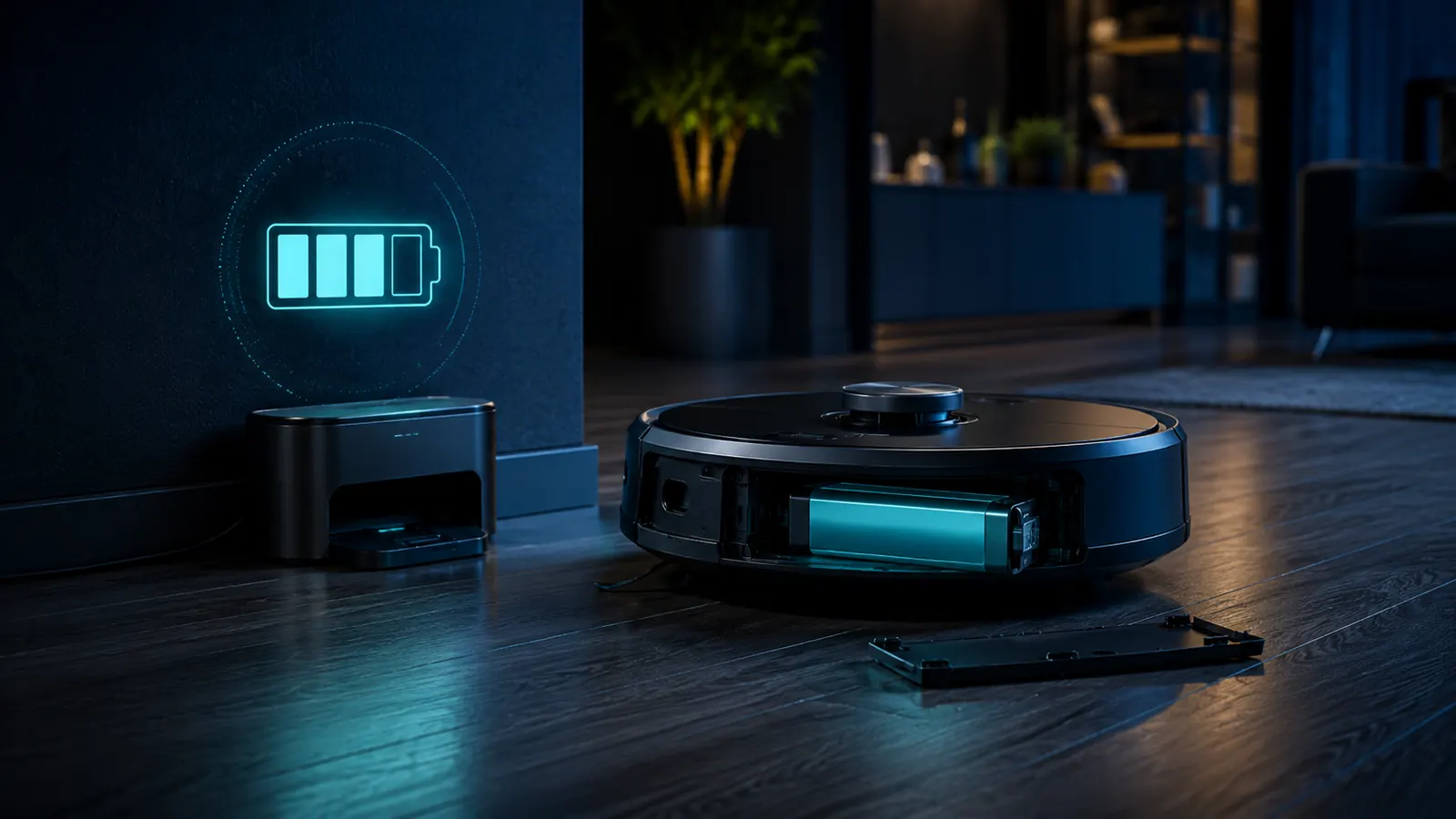
A robot vacuum with a tired battery often looks like a robot vacuum that needs replacing: it cleans less area, returns to the dock more often and may fail to finish jobs it once handled easily. But batteries are one of the most replaceable components on many robot vacuums, so declining runtime should usually trigger diagnosis before a whole-device purchase.
iRobot’s current support guidance says a properly cared-for Roomba battery should last at least two to three years before replacement. That is not a guarantee for every robot brand or household, but it is a useful benchmark for understanding that the battery is a consumable component rather than proof the robot itself is obsolete.
First rule out maintenance drag
A robot with hair wrapped around rollers, packed filters or resistant wheel assemblies has to work harder. iRobot explicitly says clogs and debris can increase strain and exhaust the battery faster. Clean the brushes, rollers, filter, wheels and charging contacts according to the model’s maintenance schedule before judging battery health.
Verify that the robot is actually charging fully
A dirty dock contact, power problem or charging error can produce short missions because the robot never starts at full charge. Confirm the app or indicator shows a normal full charge and check the dock connection. If the platform reports a charging error, follow the manufacturer’s error-specific troubleshooting rather than assuming every charging problem means worn cells.
Use runtime as evidence
iRobot publishes minimum runtime expectations for several Roomba series in its short-runtime troubleshooting guide. The company suggests a controlled test on hardwood after a full charge and says that models finishing below specified minimums may need battery replacement. The exact minimum depends on series, so use model-specific guidance.
A single unusually short mission is not enough. Carpet, obstacle density, suction mode, mapping behavior and repeated edge cleaning can all change runtime. Look for a persistent decline under similar conditions.
Battery errors can be more definitive
Some charging errors indicate permanent cell or internal battery faults. iRobot’s support pages for several charging-error codes state that the battery may need replacement if the error persists after the prescribed reset or reinstall procedure. That is stronger evidence than simply noticing a shorter cleaning cycle.
Is battery replacement economically worthwhile?
Usually the comparison is favorable when the rest of the robot is healthy. A modular battery is only one component, while replacing the robot discards motors, sensors, wheels, chassis, electronics and docking compatibility that may still be working normally.
Replacement becomes less attractive when the robot also has expensive navigation faults, damaged drive modules, unavailable brushes or no software support needed for core functions. In that situation the battery is one item in a larger repair stack.
What to check before ordering
- Exact robot model and battery compatibility.
- Whether the battery is still under warranty.
- Whether the charging dock and contacts are functioning normally.
- Whether the robot passes basic cleaning and mobility checks.
- Whether replacement batteries remain available from the manufacturer or authorized channel.
iRobot warns about non-authentic batteries on its platform and ties some charging errors and warranty concerns to aftermarket packs. Other brands have their own policies. Compatibility and safety are more important than buying the cheapest pack that physically fits.
Long-term battery care
iRobot recommends charging at room temperature out of direct sunlight, recharging after use, keeping the robot on its base when not in use and using ship mode or cool, dry storage for extended periods. Those points all reduce avoidable stress and preserve readiness.
When the battery is not the problem
If runtime is normal but the robot misses rooms, gets lost or repeatedly returns to the dock early, the cause may be mapping, sensors, software or navigation rather than capacity. Battery replacement will not fix a robot that thinks a mission is complete.
Treat battery replacement as a component repair: prove that capacity or battery electronics are the limiting factor, then replace the pack if the robot remains worth owning.
A sensible troubleshooting mindset
The goal of troubleshooting is not to replace parts until the symptom disappears. Start with observations that can separate categories of failure, change one variable at a time, and keep notes if the symptom is intermittent. This is especially important on modern products where controls can compensate for a developing fault and where one error message can have several possible causes.
Model-specific documentation should override generic internet advice. Manufacturers change component layouts, service access, error codes and maintenance requirements between generations. A procedure that is safe on one model can create leaks, electrical risk or damage on another. If a step requires live electrical measurement, refrigerant work, opening a sealed lithium pack, gas-system repair or defeating a safety interlock, it has moved beyond ordinary owner maintenance.
For Owngevity, a good repair is one that restores useful service without creating disproportionate safety, cost or reliability risk. That is why these guides separate low-risk checks from component diagnosis and why lifespan estimates are expressed as ranges instead of fake precision.
Before you spend money: document the symptom
Good troubleshooting becomes much easier when the symptom is described precisely. Note what the robot vacuum does, when it happens, whether the behavior is repeatable and whether anything changed immediately before the problem started. Record model and serial information before ordering parts or contacting service. If an error code appears, photograph it and use the manual for that exact model rather than relying on a code list for a different generation.
Also separate a performance complaint from a failure. A machine that still completes its intended job but does it less conveniently may need maintenance or an adjustment; a product that leaks, overheats, trips protection devices or cannot perform a core function has a different risk profile. This distinction keeps small issues from turning into unnecessary replacement decisions.
How to judge a repair quote
Ask what has actually been diagnosed, which part will be replaced, whether the quote includes labor and return visits, and what warranty applies to the work. A clear diagnosis with a defined part and total price is more valuable than a low estimate based on guesswork. If the repair is expensive, ask whether the technician sees evidence of other wear that could become significant soon.
Compare the quote with a genuinely equivalent replacement, not simply the cheapest product in the category. Include delivery, installation, accessories, disposal and any changes needed to fit the new product. A replacement that appears only slightly more expensive can cost substantially more once those items are added.
What Owngevity means by “repairable”
Repairable does not mean every owner should perform the repair. It means the product can reasonably be restored with available parts, appropriate tools and competent service. Electrical work, refrigerant circuits, lithium-ion battery packs, gas components and sealed pressure systems can create hazards that are not justified by a small saving. Owner maintenance should stop where the manufacturer’s documentation or your competence stops.
That distinction matters for longevity. The goal is not to keep every product alive at any cost; it is to avoid throwing away useful equipment because of a minor or misunderstood fault while also recognizing when continued repair creates poor value or unnecessary risk.
After the problem is solved
Once normal operation returns, make a short record of what caused the issue and what fixed it. This creates a useful maintenance history and can reveal patterns if a similar symptom returns. If the cause was a restriction, contamination, poor installation or neglected routine care, adjust the maintenance schedule rather than waiting for the same failure to repeat.
Finally, verify the result under normal use rather than assuming the first successful cycle proves everything is fixed. Watch for leakage, abnormal heat, new noises, repeated errors and changes in performance. A repair that restores stable operation is valuable; a repair followed immediately by new symptoms deserves another diagnosis rather than another round of random parts replacement.